-p-500.png)
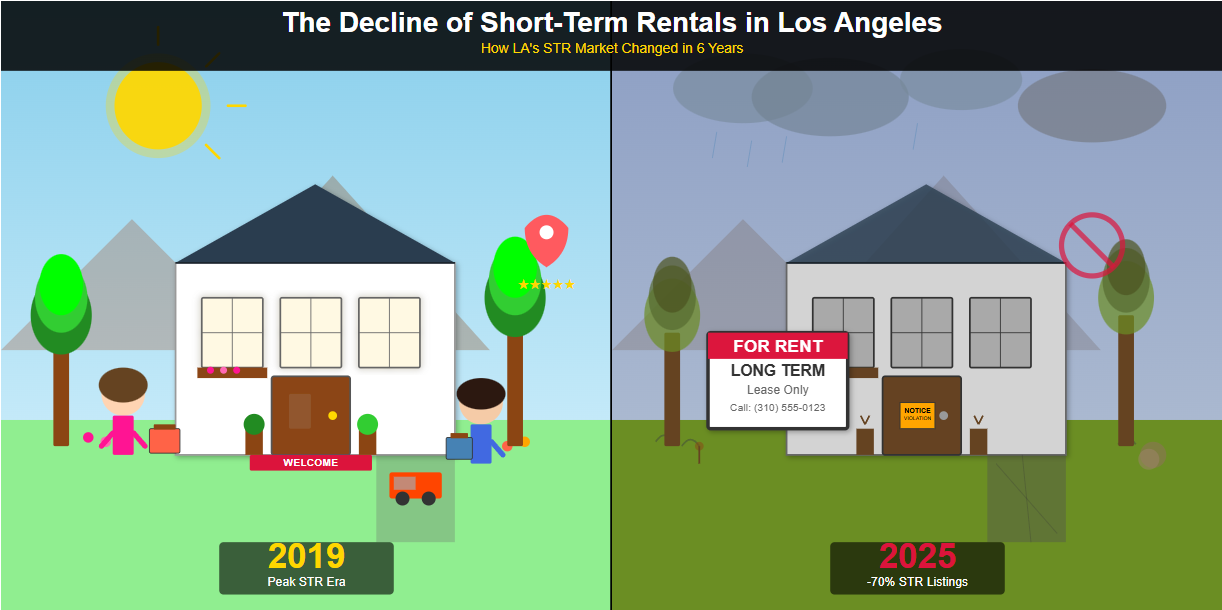

Los Angeles has long been one of the most popular cities in the world for short-term rentals, attracting millions of tourists each year with its beaches, entertainment industry, and year-round sunshine. But by 2025, the once-booming short-term rental (STR) market has shifted dramatically. Tighter regulations, reduced tourism growth, and a saturated host landscape have challenged what used to be an incredibly lucrative investment model.
So what’s driving this decline—and what does it mean for LA property owners today? Let’s break it down.
Why Short-Term Rentals Are Declining in LA
1. Continued Enforcement of Strict STR Regulations
The enforcement of the 2019 Home-Sharing Ordinance has intensified. Property owners now face:
- Stricter verification checks
- Higher fines for non-compliance
- Increased enforcement of the “primary residence only” rule
- A crackdown on unlicensed listings
Many owners who previously operated multiple listings have been pushed out of the STR market entirely, reducing supply but also discouraging new hosts from entering.
2. Lower Profit Margins Due to Market Saturation
Though LA has fewer illegal listings, the overall STR market is still densely populated. Hosts now compete heavily on:
- Price
- Amenities
- Guest experience
- Cleaning fees and policies
Revenue per listing has flattened or dropped in many neighborhoods. In 2025, simply listing a property on Airbnb is not enough to guarantee profitability.
3. Shifts in Traveler Behavior
Travelers are now more budget-conscious and often prefer:
- Longer stays
- Hotels with predictable standards
- Mid-term rentals (30+ days) offering better value
- Locations outside major cities
This has reduced the volume of short-term leisure travelers that once fueled LA’s STR boom.
4. Rising Costs for Property Owners
Property taxes, insurance, supplies, utilities, and cleaning services all continue to rise. Even owners with steady bookings have seen:
- Decreased net income
- Higher maintenance requirements
- Profitability squeezed from all sides
For many, STRs are becoming more work—and more risk—with less reward.
What This Means for Property Owners in 2025
Despite the challenges, LA property owners are not without options. The market is shifting, not disappearing—and those who adapt can still generate meaningful returns.
1. Mid-Term Rentals Are Becoming the New Sweet Spot
Stays of 30+ days are booming thanks to:
- Traveling nurses
- Business professionals
- Digital nomads
- Relocation tenants
- Film production workers
Mid-term rentals allow owners to:
- Earn higher monthly revenue than traditional long-term leases
- Avoid STR regulations entirely
- Reduce turnover, cleaning, and vacancy
For many, this has become the most stable and profitable strategy in 2025.
2. Long-Term Rentals Are Regaining Popularity
With high demand for housing and limited supply, long-term rentals provide:
- Consistent income
- Lower operating costs
- Fewer legal risks
Although not as glamorous as STRs, they offer reliability in a volatile market.
3. Professional Property Management Is More Valuable Than Ever
Compliance, pricing optimization, guest screening, and maintenance are harder to manage now. Professional managers help owners:
- Stay compliant with LA rules
- Maximize occupancy
- Handle guest communication
- Reduce liabilities
For owners who still want passive income, outsourcing is becoming essential.
4. Some Owners Are Choosing to Sell
A subset of investors has decided the declining STR profitability doesn’t justify the stress and cost. With LA home values still high, selling—especially for those who bought years ago—can be a smart financial move.
Looking Ahead: The Future of STRs in LA
While the short-term rental market in LA is “declining,” it’s not dying. It’s maturing.
By 2025 and beyond, the landscape favors:
- Hosts who follow regulations
- Owners willing to shift to mid-term stays
- Properties with flexible layouts (ADUs, studios, 1-bed units)
- High-quality, hospitality-focused operators
The days of quick and easy Airbnb profits may be over—but opportunity still exists for those who pivot with the market.